
A question that came to mind while doing the dishes: Why do some works resemble art, while others resemble ethnography?
Today, I continued researching the artists from this year's Venice Biennale.
This year's exhibition features a great number of creators from Africa, the Caribbean, the African diaspora, Indigenous cultures, and the Global South. For me, this was naturally an exciting (and also daunting) deluge of learning. To be clear, the excitement far outweighed the apprehension. Through these works, I delved into many previously unheard-of cultures and beliefs, narrative experiences, and historical traumas – it was truly exhilarating!
But while doing the dishes, a question suddenly popped into my head: When these long-underrepresented marginal cultures and non-mainstream groups are placed in international exhibitions, museums, or contemporary art institutions like the Venice Biennale, are they not easily viewed by us in a way that approaches ethnography, anthropology, or even as cultural specimens?
To be honest, this was precisely the feeling I had while viewing the exhibition with Eric in Venice.
First, it's truly a paradox, because contemporary art inherently involves extensive interdisciplinary collaboration with fields like anthropology, sociology, and cultural studies, and often borrows ethnographic methods such as field research, archival work, interviews, and community practices.
Second, there's my role: I've always served as a kind of gateway to contemporary culture, introducing audiences to art worlds they might not be familiar with. Therefore, when I encounter these works, my first reaction is often to provide explanatory background information: This is a Black community tradition, this is an African religion, this is Indigenous knowledge, this is a diaspora ritual, and so on...
While this kind of understanding is certainly necessary for an initial engagement with the work, the problem also lies here: When I approach a piece in this way, am I still able to comprehend it as a work of contemporary art?
My initial answer to myself was: Yes, I can. There's still a distinction between an artwork and a cultural artifact.
Returning to the works themselves, I want to try to self-examine using two pieces.

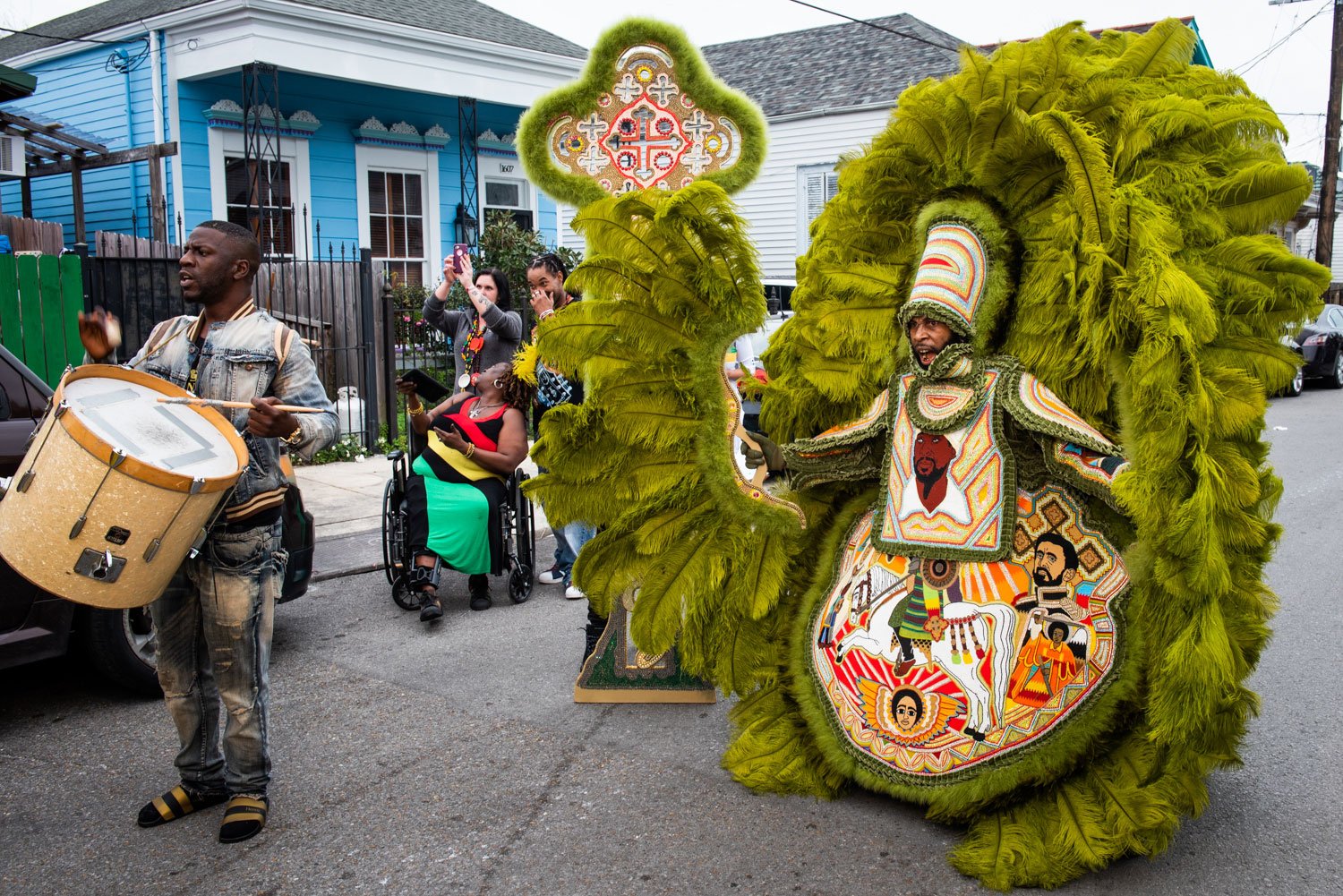
One is Big Chief Demond Melancon ’s work. He is the Big Chief of the "Young Seminole Hunters Tribe" within New Orleans' "Black Masking Culture." This tradition is linked to the ritual cultures brought to the Americas by enslaved Africans and may also have been influenced by encounters with Indigenous peoples. It remains a very important public celebratory culture in New Orleans today.
Every Big Chief wears incredibly elaborate costumes made of glass beads, sequins, feathers, fabric, and leather (weighing 30-50 kg!) on "Fat Tuesday" during the "Carnival season." These costumes are already at a sculptural level, combining complex meanings such as performance, ritual, physical labor, and community competition. Melancon began participating in "Black Masking Culture" in 1992 and later brought these beaded costumes into galleries and museums, pushing a Black community tradition, previously less understood by the international art world, into the broader art scene.
And when I looked at this piece, I indeed felt quite a nuanced sense of doubt.
It's incredibly beautiful and powerful! Super labor-intensive, with all patterns meticulously hand-stitched bead by bead. Yet, when it was hung in the exhibition space, I didn't even give it a second glance; it was only later, looking at photos, that I was amazed! Because, removed from the streets originally filled with energy and noise, with all the music, dancing, competition, and revelry of the community celebration gone, it immediately transformed (or was reduced) into a flat, traditional Black costume, a locally distinctive craft, a "cultural artifact" (often gathering dust).
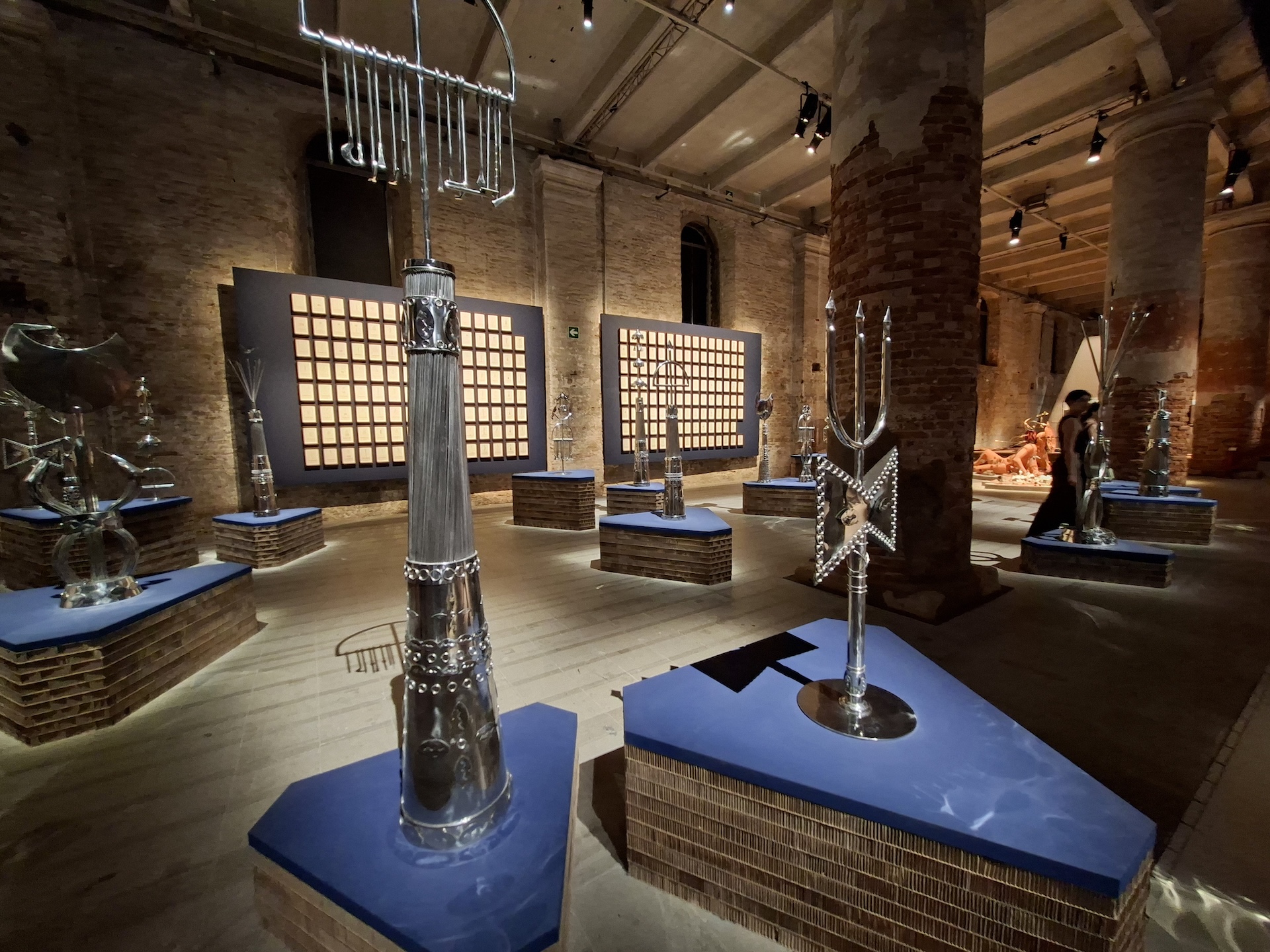
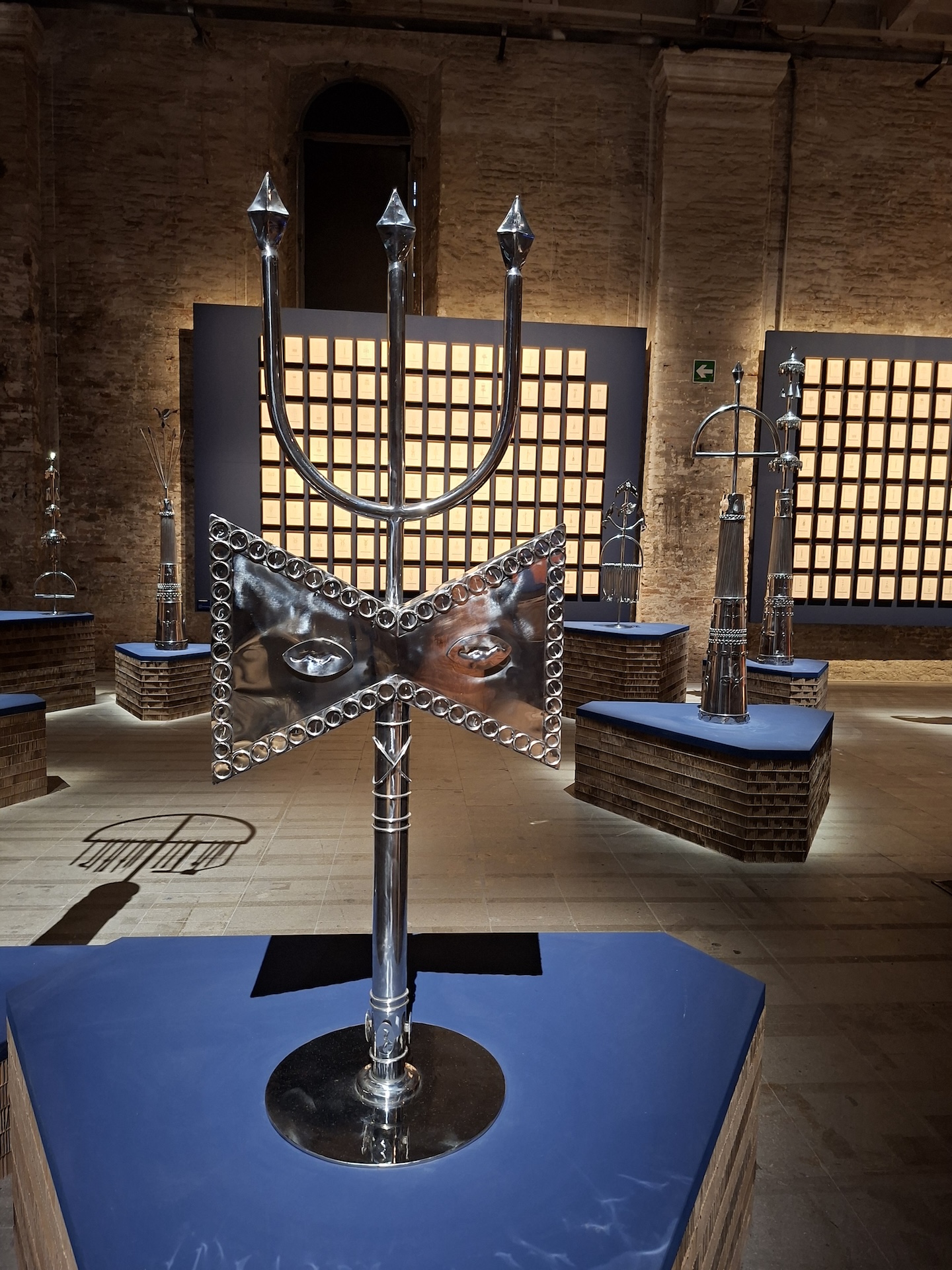
Another work had the opposite effect:Ayrson Heráclito His work. Heráclito, from Bahia, Brazil, creates art deeply connected to Candomblé Nagô Ketu. Candomblé, a religion I learned about for the first time, is a spiritual refuge woven from memory and spirituality by millions of enslaved Africans brought to Brazil, who, during their brutal years of enslavement, blended the spiritual knowledge of groups like the Yoruba.
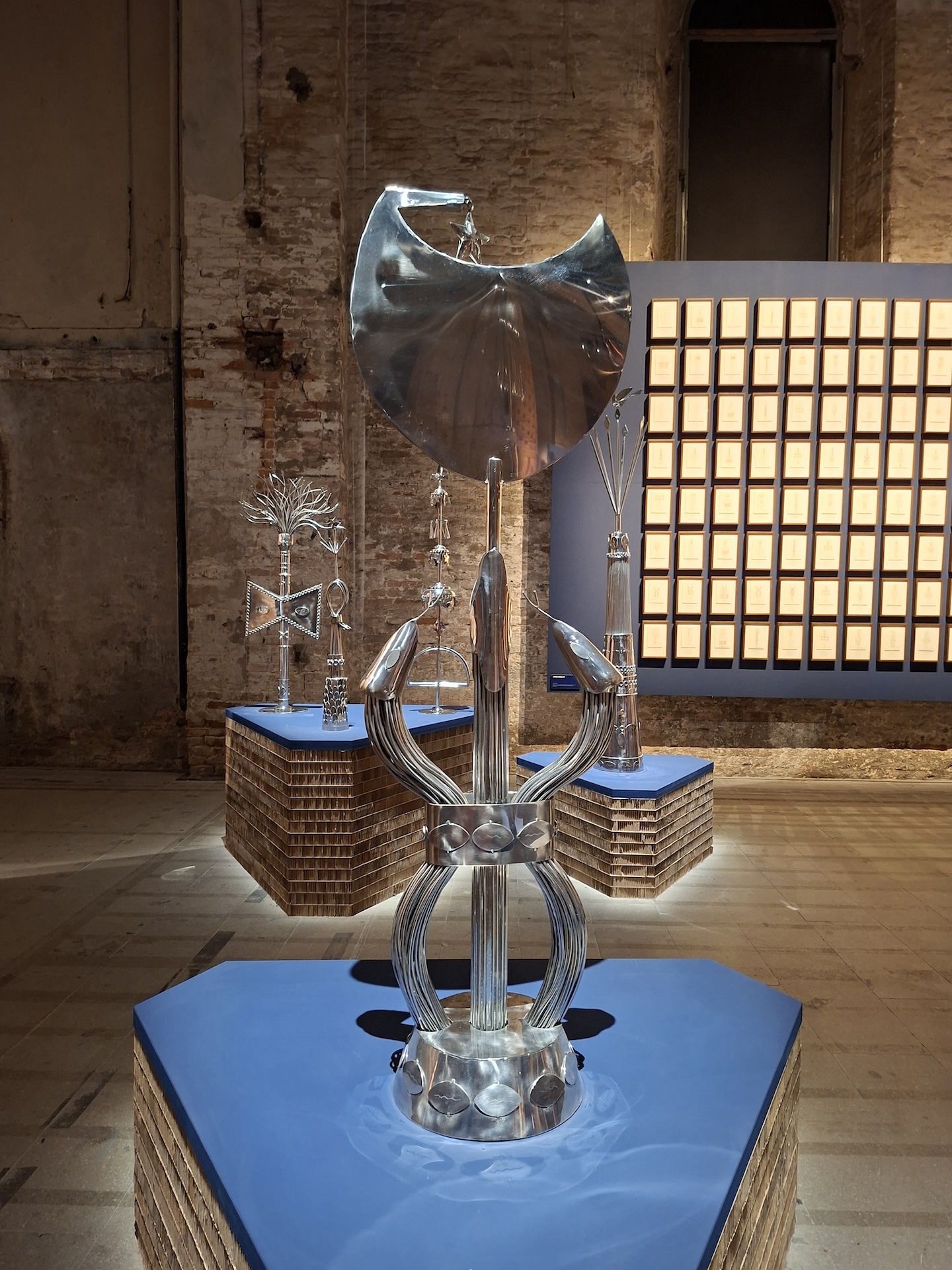
In Heráclito's work, Juntó, he addresses the 'Oríxá,' the spiritual system of Candomblé, somewhat akin to the concept of 'guardian spirits.' The artist uses stainless steel sculptures and 238 ink and watercolor paintings to correspond to various combinations of major and minor Oríxá (guardian spirits), accompanied by 'praise poems' that describe their energy.
Although Heráclito's work also stems from a 'non-Western' religion and cosmology, the work itself effortlessly made me feel like I was 'looking at a beautiful sculpture, just with some ethnic flair.' Those stainless steel sculptures resembled both religious artifacts and abstract sculptures; they evoked ritualistic tools while also possessing the minimalism, materiality, and formal conventions of contemporary sculpture.
So, I initially thought my answer was: Yes, even when both were showcasing non-Western and non-mainstream creations, I could still distinguish what felt more like 'contemporary art' (the latter) from what was more easily framed as craft or cultural display (the former).
However, this answer quickly led me to a second question.
I continued to ask myself: But why did I find Melancon's work more easily perceived as 'culture' or 'craft,' while Heráclito's seemed more like 'art'? Didn't this judgment itself expose my own training?
Upon closer reflection, there was indeed a double standard here. If a white artist from France or the United States were to create work in a similar vein of community, gatherings, relationships, and celebrations, we would likely not immediately label it as ethnography, but would quickly find a set of art historical or theoretical terms for it: relational aesthetics, social practice, participatory art, institutional critique... and firmly place it within the context of contemporary art.
However, when similar community-based, ritualistic, or non-object-oriented practices came from an unfamiliar, exotic cultural background, such as Black African cultures, I was more prone to bypass these frameworks and directly categorize it as ethnographic 'cultural presentation.' This differential treatment forced me to re-examine my own criteria for judgment.
The reason I found Heráclito's work 'more artistic' was likely because it more closely resembled the contemporary art language I was familiar with: abstraction, metal materials, refined forms. Although he transformed Candomblé's religious cosmology into stainless steel sculptures and a series of images, it wasn't a direct presentation of culture (which would be too unsophisticated!). Through a 'transformation' recognizable by academia and museums, these works could easily be placed within the existing language of contemporary art, and thus were more readily perceived by me as 'art'.
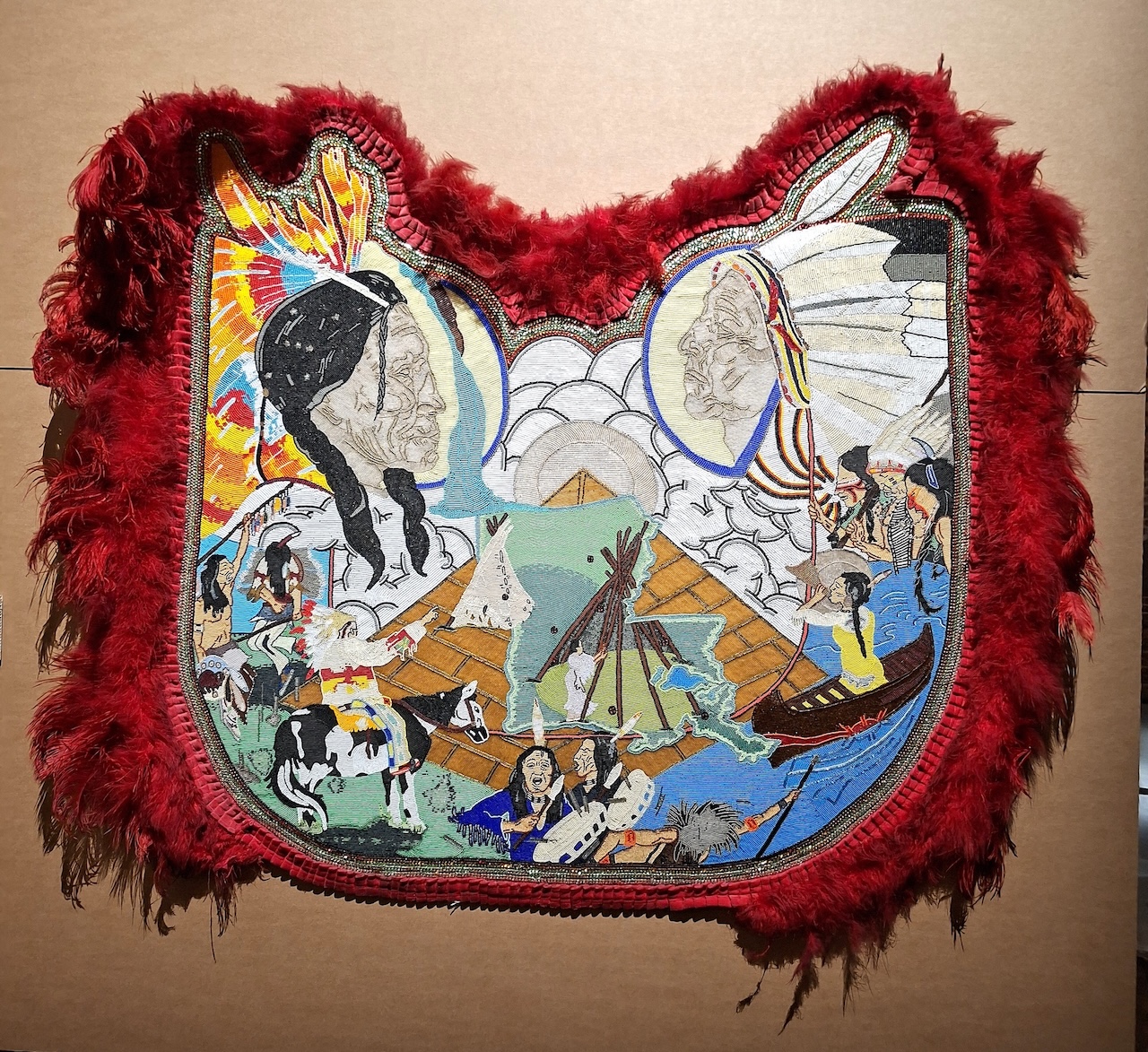
Melancon's work, by contrast, is so deeply connected to (and dependent on) its original community life, so overtly preserving its handcrafted, festive, competitive, street, and ritualistic qualities, that it tends to be pigeonholed into the realms of ethnography or craft.
This contrast made me realize that my judgment of what constitutes "artistic merit" in my mind is quite biased. It's not just about the work itself, but also about my eyes and mind, which have been "institutionally trained" by contemporary art.
Does this imply that a marginalized culture is only more readily recognized as art when it can be translated into a language "familiar to contemporary art institutions"? If so, how should creations that remain strongly connected to community, body, ritual, and daily life be understood?
These questions left me without an answer, but they also made me realize that perhaps the entire premise of the question is flawed, because such works can never be fully understood in such a context! As long as we are not standing on the streets of that carnival, as long as we are not immersed in that battle dance with its elaborate costumes, as long as we are not part of the same community sharing the faith and will embedded in these day-and-night crafts, then Melancon's "Black masking culture" will forever remain merely an exotic curiosity to us.
More importantly, however, this work exposes the limitations of the institutional system: when the core of a work is not merely an object, but rather community, procession, sound, body, festivity, competition, and heritage, it transcends the scope of the institution. What museums can preserve and display is often only the most easily objectified parts. Therefore, the reason Melancon's work created a dilemma of "ethnographic viewing" for me lies more in the narrowness of the entire museum system, which, when confronted with vibrant community practices, can often only transform them into a cultural object that can be admired from afar yet also trivialized, becoming a cultural specimen.
-
These musings stem from my reflections on this Biennale.
I decided not to write an overall, generalized, objective analysis, because I believe everyone can find various reviews in different media. I will only write about the micro-reflections that interested me and sparked my curiosity in the details.
.
#VeniceBiennale #ContemporaryArt #AfricanContemporary
Viki Kuo
From Taoyuan. Since 2007, she has worked in contemporary art galleries and museums in Taipei, Beijing, and Shanghai, focusing on exhibition planning, artist research, and observation of the art scene. After moving to Paris in 2020, she became responsible for planning and teaching art courses for Paris–Taipei Express. She focuses on guiding students to understand the creative concepts, art historical/cultural backgrounds, and viewing methods of contemporary art, drawing on a researcher's perspective and firsthand experience in the art world. To date, Viki Kuo / Paris-Taipei Express has organized and offered over 60+ online and in-person (Paris/Taiwan) lectures and courses. She has served as an art lecturer at institutions including EAC French School of Art and Culture Management (2024) and IESA Paris School of Arts and Culture Management (2024–2026) in Paris, OneArt Taipei Art Fair (2024–2025), as well as the Lufu Life Aesthetics Foundation and Tongxue She.
Follow
